History
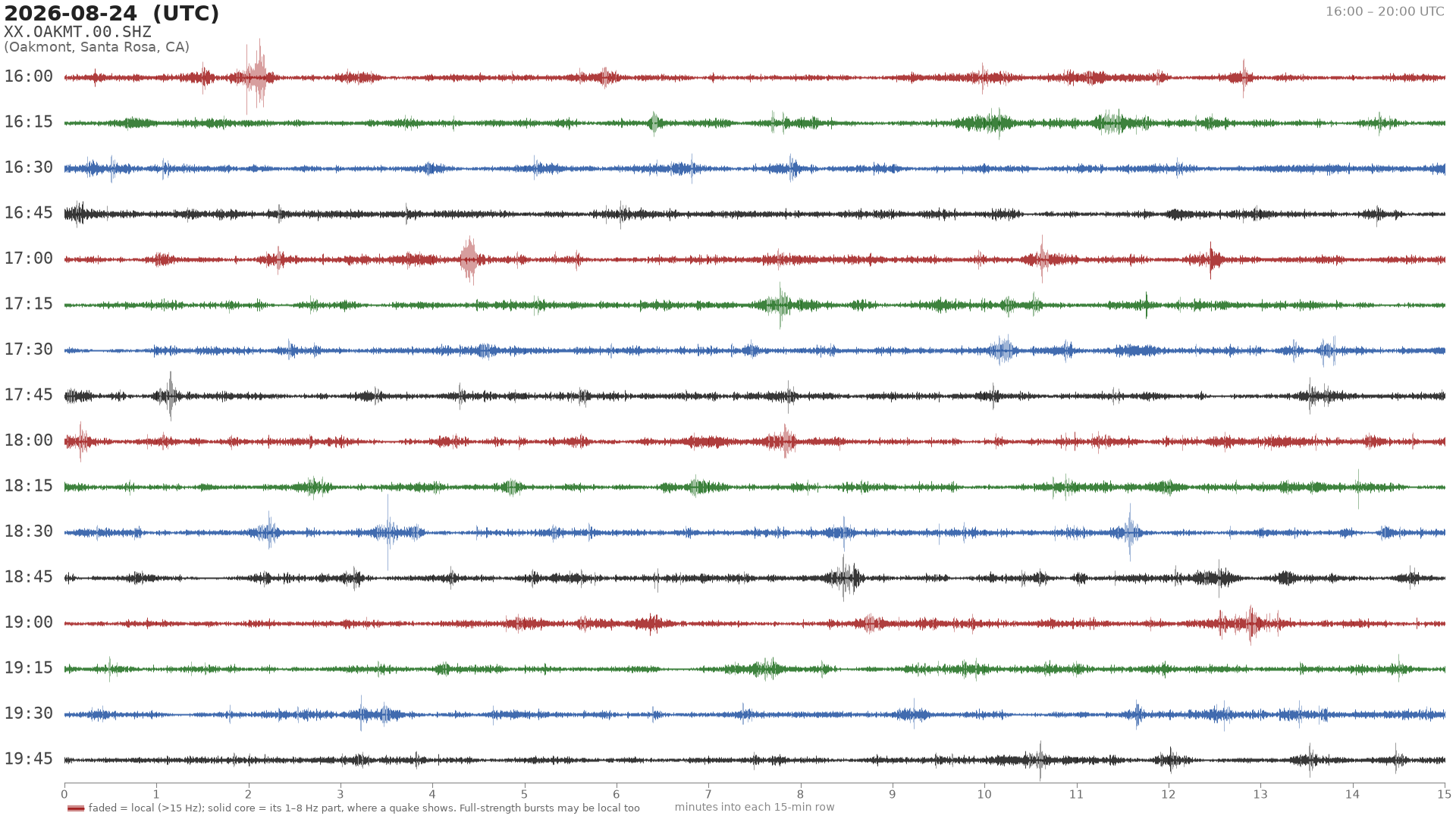
Same 1 Hz high-pass as the live drum. The amplitude scale is keyed to each window’s own median noise, so a quiet night is not drawn smaller than a busy afternoon — compare shapes across windows, not heights. A blank row means no data for that 15 minutes.
Each row is 15 minutes of ground motion, oldest at the top — read it like lines on a page. Height means how hard the ground moved, so an earthquake is a sudden fat burst that tapers away, while ordinary noise is an even fuzz.
The four colours carry no meaning. They cycle red, green, blue, black purely so your eye can follow one row without sliding into the next. This is a single sensor recording a single channel — not four feeds at once.
Faded stretches are things happening nearby — footsteps, a door, a car. They are identified by pitch: only something within a few metres arrives with energy above 15 Hz, because distance strips the high frequencies out of a real earthquake. The solid core drawn inside a faded burst is the 1–8 Hz part, the band a quake would occupy.
Coloured triangles mark where an earthquake from the USGS catalogue should have arrived — where to look, not a claim that this station caught it. Full guide to reading the drum →
The station switched to 100 sps late on 2026-07-25, and before that ran at 57/60 sps through a different analog front end. Earlier recordings exist but are not comparable to these, so they are deliberately not offered here rather than inviting a like-for-like reading that would be wrong.