Live spectrum · same 30 s window · ASD µV/√Hz, log–log
Helicorder · last 4 hours (UTC)

Each row is 15 minutes of ground motion, oldest at the top — read it like lines on a page. Height means how hard the ground moved, so an earthquake is a sudden fat burst that tapers away, while ordinary noise is an even fuzz.
The four colours carry no meaning. They cycle red, green, blue, black purely so your eye can follow one row without sliding into the next. This is a single sensor recording a single channel — not four feeds at once.
Faded stretches are things happening nearby — footsteps, a door, a car. What marks them is not the presence of high frequencies but the balance: a burst is faded when it carries more energy above about 15 Hz than it does in the 1–8 Hz band where earthquakes put most of theirs. Distance does strip the high frequencies out of an earthquake, but over tens of kilometres, not metres — the M3.3 under Larkfield-Wikiup was still 16× above the noise floor at 35–50 Hz from 13 km away, and people heard it as a sound. It is not faded here because that energy, real as it was, is a small fraction of what arrived lower down. The solid core drawn inside a faded burst is the 1–8 Hz part, the band a quake would occupy.
Coloured triangles mark where an earthquake from the USGS catalogue should have arrived — where to look, not a claim that this station caught it. Full guide to reading the drum →
See what a real earthquake looks like on this drum → the M4.2 Cloverdale quake of 29 July 2026, 45 km away
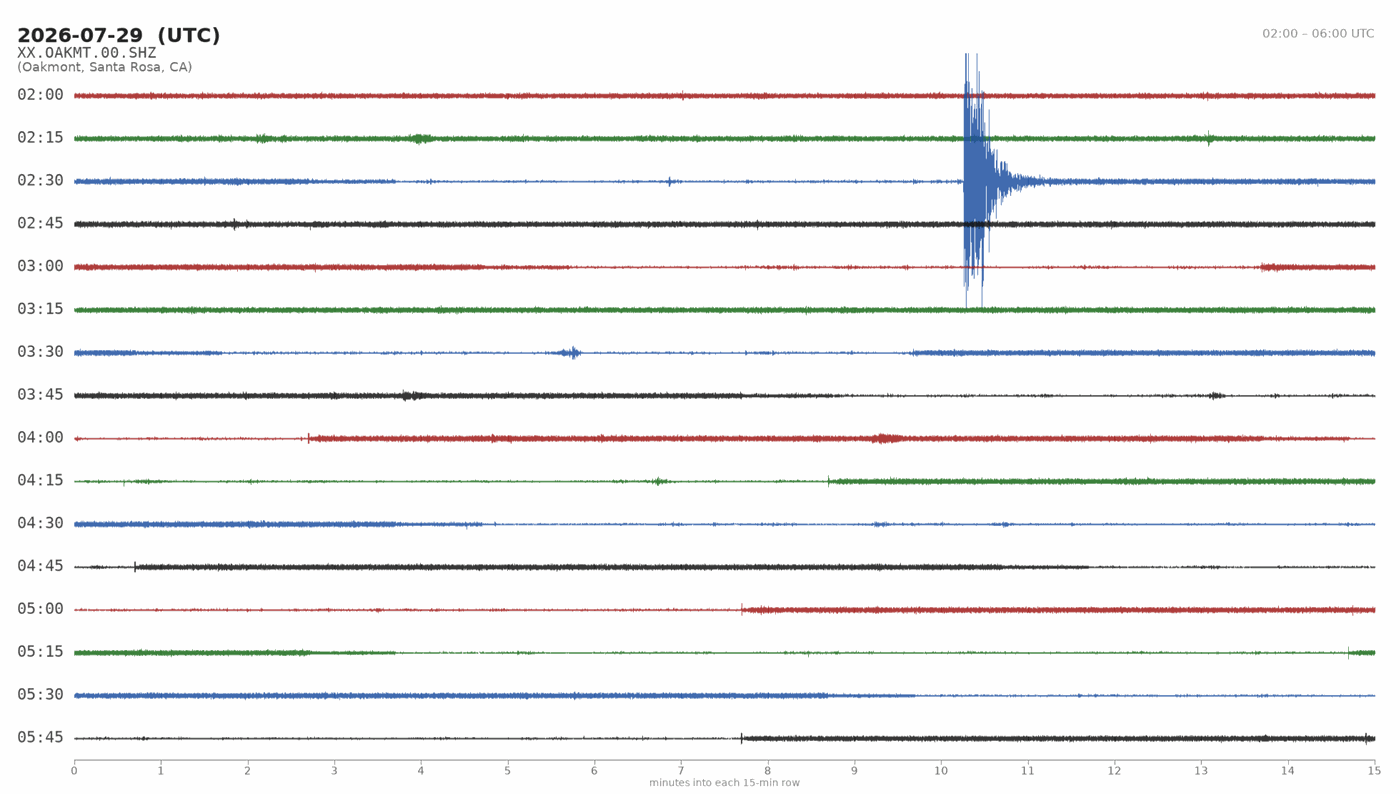
Nothing like the little bursts. At 02:40 UTC the trace swings three rows up and three rows down — the drum clips there on purpose, so a big event reads as a big event without wrecking its neighbours — and takes about 80 seconds to die away, tapering the whole time. Everything else on these four hours is the ordinary fuzz of a summer night: cars on the highway, the air conditioner, a door. People in Santa Rosa felt this one as a single jolt.
The small blip on the 03:45 row, about 3½ minutes in, is a M2.2 aftershock from the same spot — what a quake nobody feels looks like: a burst that still starts sharp and tapers, just a hundred times smaller.