M2.3 · 5 km SSW of Alameda, CA
one catch · SS.OAKM1.00.EHZ
M2.3 · 5 km SSW of Alameda, CA
2026-08-21 11:38:49 UTC · 88.6 km (SSE) · depth 16.5 km
- magnitude
- 2.3
- distance
- 88.6 km
- depth
- 16.5 km
- envelope peak
- 5 µV
- envelope SNR
- 5×
- P predicted
- 15.2 s
- sustain
- 6.9 s
- low/high band
- 1.9×
- vs NP.1835
- 1.05×
P
S
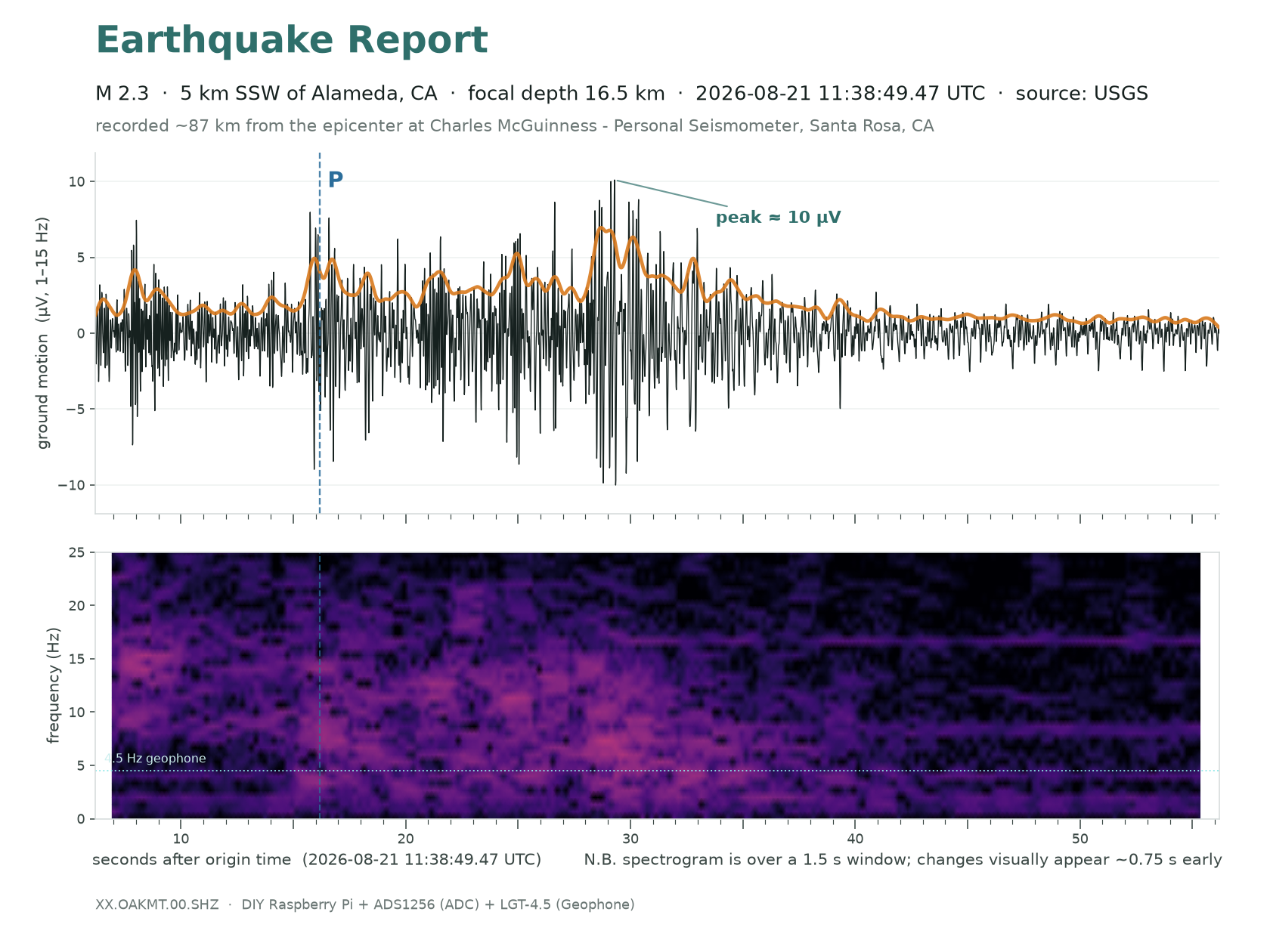
Listen for how the pitch balance changes at the P wave (marked where it was picked), at the S wave (the dashed mark is its predicted arrival) and through the coda that follows. Volume is normalised to this clip, so it only says how much energy there is before, during and after the event relative to its own peak — not how big the earthquake was.
- This is where measurement stops and extrapolation starts. At 88.8 km it is the most distant event in the range fit, edging out the M3.8 San Leandro at 88.0 km — and the dashed circle on the range map is drawn from it. Everything outside that line on the map is inference; this is the last point that is measurement.
- It is also nearly the faintest thing here. Peak 4.6 µV against a 0.76 µV floor — a signal-to-noise of 6.1, and the 10th quietest of the 60 confirmed catches. An M2.3 is an ordinary earthquake; at 89 km it arrives as a few microvolts and eleven seconds of shaking that would be invisible on any casual look at the trace.
- Most of the distance is downward. The hypocentre is deeper than 16 km against a median of 4.2 km for everything else on this page — roughly four times the usual, and depth counts in full toward the distance the wave actually travelled. A shallower earthquake at the same map position would have arrived louder. (The table says 18.2 km and the figure says 16.5: USGS revised it between the two, which is exactly why the harvest re-runs a week after every event rather than trusting the first solution.)
- The reference station agrees to within 5 %. Against USGS NP.1835, 1.64 km away, the amplitude ratio is 1.05. At the very edge of what this instrument can hear, it is still reading the ground correctly rather than reading itself.
- Nobody chose this one. It is on this page because the superlative rule computed it from the record, and it had been sitting in the table unremarked while the page gave the “furthest fitted” title to a nearer event.
Independent station. Times are UTC. Built by Charles McGuinness.