M1.8 · 6 km ESE of Santa Rosa, CA
one catch · SS.OAKM1.00.EHZ
M1.8 · 6 km ESE of Santa Rosa, CA
2026-08-29 00:42:16 UTC · 10.4 km (SSW) · depth 9.8 km
- magnitude
- 1.8
- distance
- 10.4 km
- depth
- 9.8 km
- envelope peak
- 78 µV
- envelope SNR
- 25×
- P predicted
- 2.0 s
- sustain
- 3.4 s
- low/high band
- 3.0×
- vs NP.1835
- 1.12×
P
S
Listen for how the pitch balance changes at the P wave (marked where it was picked), at the S wave (the dashed mark is its predicted arrival) and through the coda that follows. Volume is normalised to this clip, so it only says how much energy there is before, during and after the event relative to its own peak — not how big the earthquake was.
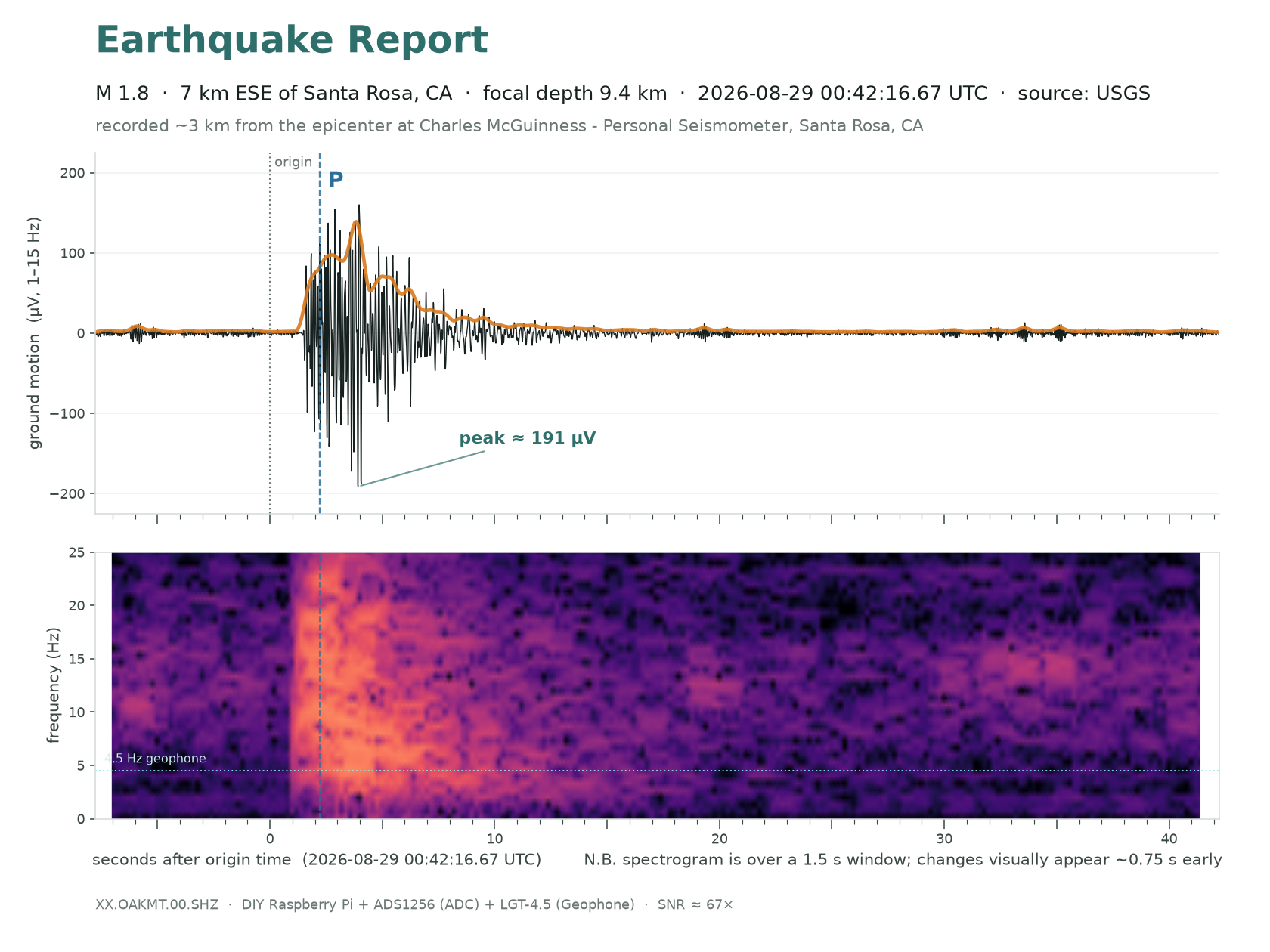
- The closest catch. 2.8 km on the map, but 9.4 km down, so the real distance is 9.9 km and almost all of it is depth — this one arrived from below. Nothing catalogued had come within 8.4 km of the station before that night.
- Peak 191 µV, signal-to-noise ~67×, detector ratio 585 — from an M1.8. The M2.5 at 18 km managed 117 µV and the M4.2 at 46 km 1,406 µV: at this range distance matters far more than magnitude.
- The high frequencies survived. Every other catch here arrives low-frequency because kilometres of rock strip the highs out on the way. There is no such path here, and the spectrogram shows energy right up to ~24 Hz at onset. This is the event that shows the rule is about the path, not about earthquakes.
- First motion +1.47 s after origin — ~0.4 s earlier than the station’s 5.19 km/s crustal velocity predicts. That figure was fitted to 18–90 km paths through shallow crust; this ray went almost straight up from 9.4 km, through deeper and faster rock.
- It had an aftershock, and that one was recorded too: M1.38 at 04:13:48 UTC, 3½ hours later and from the same 2.9 km spot. Predicted P at 04:13:49.7, trigger at 04:13:50.0, peak 43.6 µV. The classifier gave it only p = 0.13, though — a very local quake is broadband and impulsive, which is exactly what cultural noise looks like, and the model was trained on 19 positives that are mostly further away. Close events are its blind spot.
- It should have sent a push notification and did not. Re-scored afterwards the trigger classifier gives it p = 0.988, comfortably past the 0.7 alert threshold — but the detector released the trigger before the last seconds of its scoring window had arrived from the station, so it was never scored and the alert never fired. Found and fixed the same day.
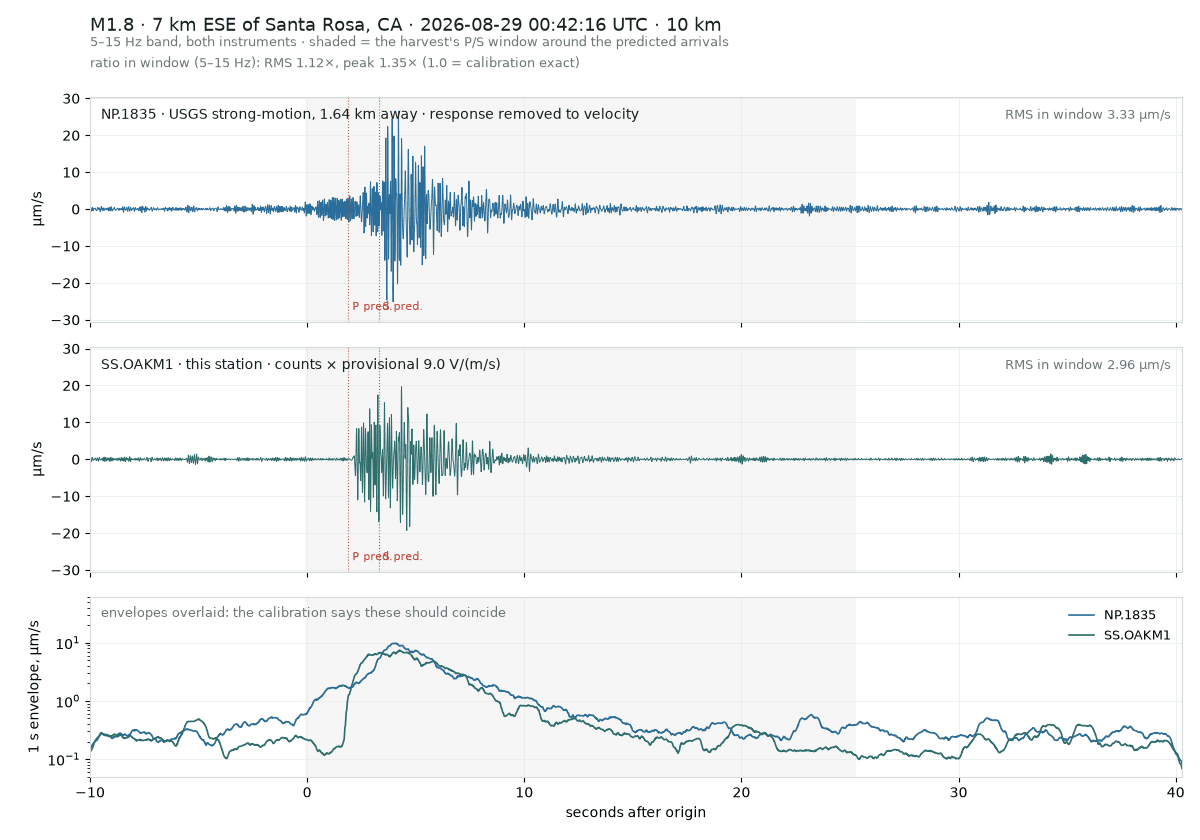
Side by side with USGS NP.1835, 1.64 km away, both in ground velocity.
Independent station. Times are UTC. Built by Charles McGuinness.