M4.2 · 8 km ESE of Cloverdale, CA
one catch · SS.OAKM1.00.EHZ
M4.2 · 8 km ESE of Cloverdale, CA
2026-07-29 02:40:06 UTC · 45.8 km (NW) · depth 5.9 km
- magnitude
- 4.2
- distance
- 45.8 km
- depth
- 5.9 km
- envelope peak
- 520 µV
- envelope SNR
- 192×
- P predicted
- 7.9 s
- sustain
- 12.9 s
- low/high band
- 55.5×
- vs NP.1835
- 0.74× †

P
S
Listen for how the pitch balance changes at the P wave (marked where it was picked), at the S wave (the dashed mark is its predicted arrival) and through the coda that follows. Volume is normalised to this clip, so it only says how much energy there is before, during and after the event relative to its own peak — not how big the earthquake was.
- The biggest signal this station has recorded — though no longer the biggest earthquake. Peak 1,406 µV in 1–15 Hz against a ~1.5 µV floor, an ~80 s coda, and a detector ratio of 8,535, where the previous record was 645. The M4.8 off Petrolia is the larger quake — 0.6 magnitude units, about four times the amplitude at the source — and it arrived here at 52 µV, 27 times smaller, because it happened 319 km away instead of 46.
- Not remotely clipped: the whole event used ~3.5 % of the digitizer’s range.
- First arrival at +9.06 s. That was 1.4 s later than the textbook P-velocity predicted, and with four other events the same day it pinned the station’s own crustal velocity at 5.19 km/s — the number every prediction on this site now uses.
- Four more confirmed events the same day: three aftershocks at 46 km and an M1.5 near Angwin at 29 km.
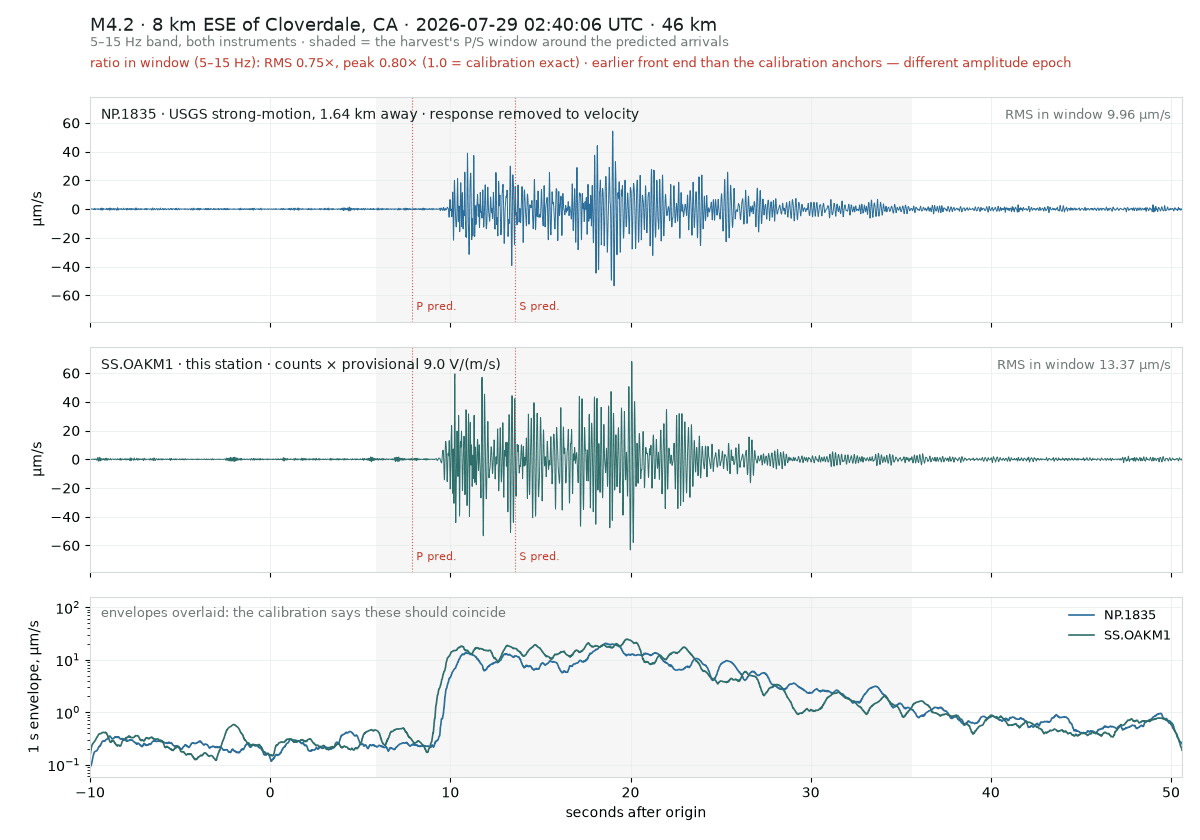
Side by side with USGS NP.1835, 1.64 km away, both in ground velocity. Earlier front end than the calibration anchors, so the ratio is not averaged in.
Independent station. Times are UTC. Built by Charles McGuinness.