M1.2 · 7 km ESE of Santa Rosa, CA
one catch · SS.OAKM1.00.EHZ
M1.2 · 7 km ESE of Santa Rosa, CA
2026-08-29 04:13:48 UTC · 9.4 km (SSW) · depth 8.8 km
- magnitude
- 1.2
- distance
- 9.4 km
- depth
- 8.8 km
- envelope peak
- 13 µV
- envelope SNR
- 5×
- P predicted
- 1.8 s
- sustain
- 3.8 s
- low/high band
- 1.6×
- vs NP.1835
- 0.86×
P
S
Listen for how the pitch balance changes at the P wave (marked where it was picked), at the S wave (the dashed mark is its predicted arrival) and through the coda that follows. Volume is normalised to this clip, so it only says how much energy there is before, during and after the event relative to its own peak — not how big the earthquake was.
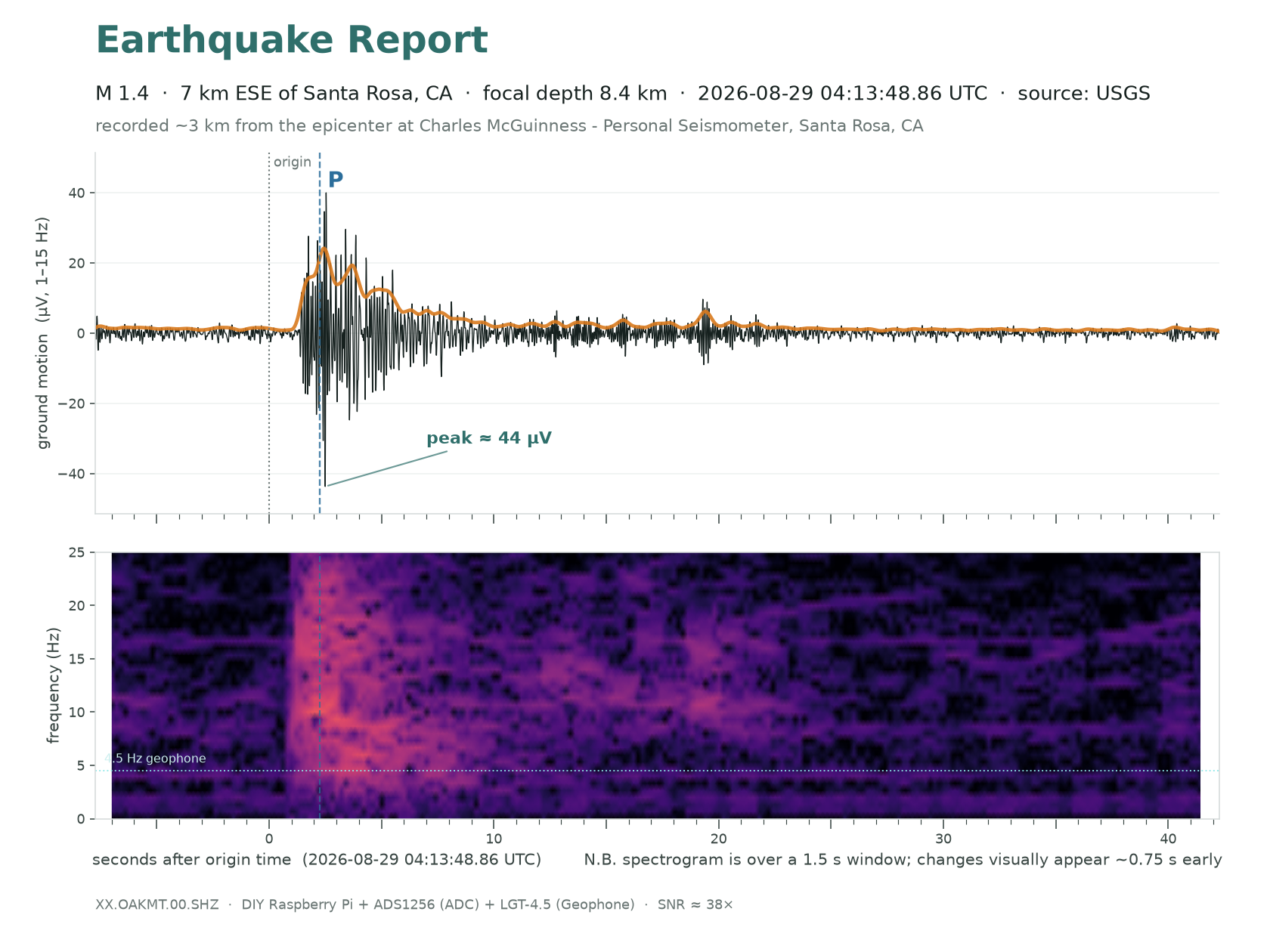
- Nearly all of that distance is straight down. The epicentre is only 3.2 km away across the ground, and the hypocentre is 8.4 km beneath it — so the ray arrives about 21° from vertical. This is the closest thing in the record to an earthquake happening directly under the garage, with the energy coming up rather than along.
- P lands 1.74 s after the rupture. There is very little to wait for: at 9 km the first arrival is quicker than the pause between two words.
- An M1.4 is barely an earthquake, and it is unmistakable here. 13.3 µV against a 2.4 µV floor. Compare the M2.3 near Alameda on this page: nine times the energy at the source, arriving three times fainter, purely because it had 89 km of crust to cross.
- Two events can both be “closest”. This one is nearest through the rock at 9.0 km. The M1.8 later the same morning is nearer across the map — 2.7 km epicentral — but 9.9 km once its 9.4 km of depth is counted. Every distance on this site is hypocentral, the distance the wave actually travelled, which is the one the amplitude cares about.
- Short. The shaking holds above the floor for 3.8 s. Small and near means a brief, sharp event rather than the long trains the distant ones produce.
Independent station. Times are UTC. Built by Charles McGuinness.